Devolution: Necessary but Not Sufficient
Devolution is a necessary but not sufficient condition for building a ‘high dynamism, wide inclusion’ economy in the UK. I want to say that plainly at the outset because too much of our national debate treats devolution as a silver bullet.
The international evidence is clear: devolution only works when there is a national social contract in place that respects ‘mass flourishing’ (Nobel economist Edmund Phelps) or universal well-being (OECD). We don’t have the necessary social contract in place to achieve devolved growth.
Economic growth per se is also necessary but not sufficient for a ‘mass flourishing’ future here in Britain. The UK economy is five thousand times bigger than it was in the 1840s when Charles Dickens published Oliver Twist — so how can it be that four million children are living in poverty as I write? What would Dickens, the great social reformer, make of the waves of devolved growth initiatives coming out of the two Number 10s?
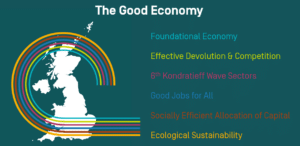
Devolution needs to be part of a more self-reliant and resilient vision of the UK’s economic future. It is one of the six axiomatic features of what I have called “The Good Domestic Economy”. The ‘Domestic’ conveys my key argument that we need to be investing much more in ‘our own backyards’, from country to neighbourhood.
We don’t have an under-investment problem in this country. Instead, we have a mis-investment problem. The misallocation costs of financialisaton are reckoned to be 2% of GDP. The opportunity cost of not investing in our so-called SME Backbone is another 2%. Add to this the trade costs of Brexit at 2%. There isn’t a ‘productivity puzzle’ for devolution to solve, not really.
Let’s imbue this vision into the Local Growth Plans, the new policy implementation frameworks for devolved growth. Let’s do this whilst avoiding yet more ‘institutional clutter’. The OECD’s description of why economic development has failed in the UK is clear: institutional change takes time. Many devolved institutions are still building their capabilities, their partnerships and their delivery models.
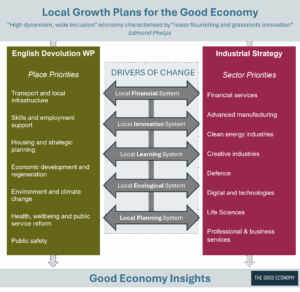
Here is my schema for Local Growth Plans as holistic blueprints for devolved growth based on investing in the ‘whole economy’ — not just ‘key sectors’. The dynamism and strength of a local Good Economy comes from five ‘systems’ of cross-sector collaboration — Financial, Innovation, Learning, Ecological, and Planning. I like the place-based partnership model in health, championed by The King’s Fund. But for all this to work, businesses and investors, both big and small, should partner up and get behind local authorities, NHS trusts, social enterprises and community groups. Local Growth Plans need to be based on shared value creation and spatial confluences of public, private and social capital.
The Good Economy 2026 ©
At The Good Economy, we see the opportunity to transform our country through thoughtful collaboration across these five drivers of change. Get this right and we have a real chance of change. Local Growth Plans should treat place-based and sector-based investment as mutually reinforcing drivers of economic development. Put the two together and we have a bicycle — not a monocycle — to ride into the future.