Devolution: Necessary but Not Sufficient
Devolution is necessary, but not sufficient, if the UK is to build an economy that is both dynamic and inclusive. I want to say that plainly at the outset, because too much of our national debate treats devolution as a silver bullet.
The problem
The international evidence is clear: devolution works only when there is a national social contract committed to everyone’s well-being. The Nobel economist Edmund Phelps calls this “mass flourishing”; the OECD calls it universal well-being. The UK doesn’t have that social contract, so devolution alone won’t deliver growth that reaches everyone.
Growth itself is also necessary but not sufficient. The UK economy is five thousand times bigger than it was in the 1840s, when Charles Dickens published Oliver Twist. Yet as I write, four million children are living in poverty. What would Dickens, the great social reformer, make of the wave of local growth initiatives now coming out of Downing Street?
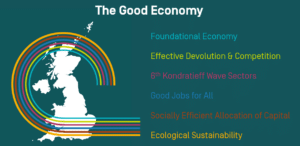
Devolution needs to sit within a more self-reliant and resilient vision of the UK’s economic future. It is one of six building blocks of what I call “The Good Domestic Economy”. The word “domestic” is the heart of my argument: we need to invest much more in our own backyards, from the nation down to the neighbourhood.
Britain doesn’t have an under-investment problem. It has a mis-investment problem: money is going to the wrong places. Estimates suggest that:
- channelling money into finance rather than the productive economy costs around 2% of GDP
- failing to invest in small and medium-sized businesses, the backbone of the economy, costs another 2%
- Brexit’s extra trade costs take a further 2%
That adds up to roughly 6% of GDP. So there is no real mystery, no “productivity puzzle”, for devolution to solve. We already know where the value is leaking out. The task is to redirect investment.
The plan
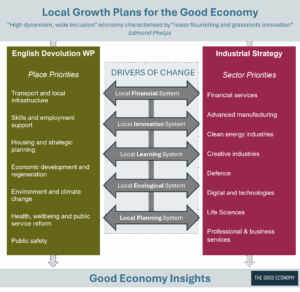
The place to put this vision into practice is Local Growth Plans, the new frameworks that set out how devolved growth will be delivered. We should do it without creating yet more new bodies and schemes. As the OECD has pointed out, institutional change takes time, and many devolved institutions are still building their skills, partnerships and ways of delivering.
I see Local Growth Plans as blueprints for investing in the whole local economy, not just a handful of “key sectors”. A strong local economy rests on five systems, each bringing public, private and community organisations together:
- Financial: getting patient investment into local businesses and projects
- Innovation: turning ideas into new products, services and jobs
- Learning: giving people the skills that local employers need
- Ecological: protecting nature and supporting the move to net zero
- Planning: land, housing and infrastructure that make places work
The Good Economy 2026 ©
What it takes
A good model already exists in health. The King’s Fund has championed place-based partnerships, in which local NHS bodies, councils and community organisations plan together for a whole area. Local economies need the same approach.
That means businesses and investors, large and small, teaming up with local authorities, NHS trusts, social enterprises and community groups. Local Growth Plans should create value that everyone shares, bringing public, private and community money together in the same places.
At The Good Economy, we see a real chance to transform the country through this kind of collaboration across all five systems. The key is for Local Growth Plans to treat investment in places and investment in sectors as partners, not rivals. Put the two together and we have a bicycle, not a monocycle, to ride into the future.